
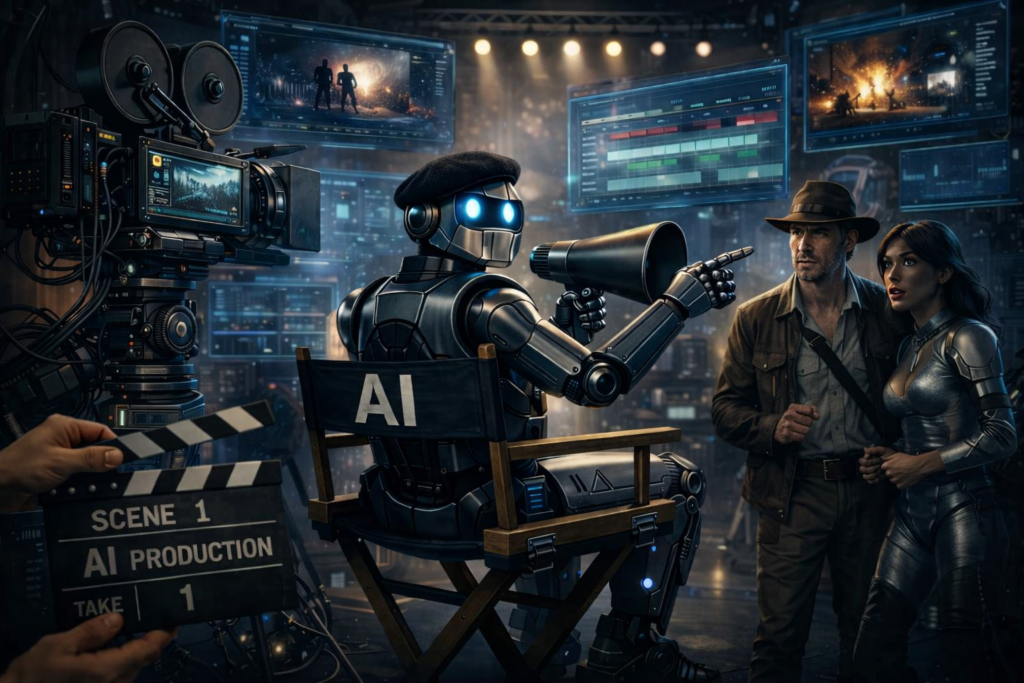
For more than a century, the movie industry has relied on imagination, storytelling, and an enormous amount of work behind the scenes. Directors, editors, writers, actors, and visual effects artists all collaborate to bring a story to life on the screen.
Recently, a new collaborator has entered the filmmaking process. It does not ask for coffee breaks, it does not forget its lines, and it can analyze millions of pieces of data in seconds.
That collaborator is Artificial Intelligence.
AI is rapidly becoming one of the most powerful tools in modern filmmaking. It can assist with generating story ideas, enhancing visual effects, organizing footage, predicting audience preferences, and helping studios market films more effectively.
Some filmmakers see AI as an exciting creative tool. Others worry that it could replace human roles or reduce creativity to predictable formulas.
Like most technological changes, the truth likely lies somewhere in the middle.
AI is not replacing Hollywood, but it is certainly changing the way films are made.
The History of Technology in Movies
To understand why AI is entering the film industry, it is important to remember that movies have always evolved alongside technology.
In the early days of cinema, films were completely silent. Actors relied on exaggerated facial expressions and physical gestures to communicate emotions because audiences could not hear dialogue.
Everything changed in 1927 with the release of The Jazz Singer, one of the first films to include synchronized sound. Audiences were amazed to hear actors speak on screen, and the era of silent films quickly came to an end.
Several decades later, computers began transforming visual effects.
The film Jurassic Park demonstrated how computer generated imagery could create realistic creatures on screen. The dinosaurs looked so convincing that many viewers felt as if extinct animals had truly returned to life.
Technology continued advancing with films like Avatar, which used motion capture and digital environments to build entire alien worlds.
Each new technology expanded what filmmakers could create.
Artificial Intelligence is simply the next step in that long history of innovation.
How AI Is Transforming the Movie Industry
Artificial Intelligence refers to computer systems that can analyze data, recognize patterns, and make decisions based on that information.
In filmmaking, AI can study large amounts of data from scripts, footage, and audience behavior. This allows studios and creators to make more informed decisions throughout the production process.
AI can assist with several parts of filmmaking, including:
- Scriptwriting and story development
- Visual effects and animation
- Film editing
- Marketing and audience analysis
Instead of replacing filmmakers, AI often acts as a powerful assistant. It can perform complex analysis quickly while humans focus on creativity and storytelling.
In many ways, AI functions like an extremely efficient assistant who has read every movie script ever written.
AI in Scriptwriting and Story Development
Every film begins with a story. However, writing a screenplay is not always easy. Writers can spend months or even years developing characters, dialogue, and plot structure.
AI tools can assist with this process by analyzing thousands of scripts to identify storytelling patterns.
For example, many successful films follow a three act structure. The first act introduces the characters and the main conflict. The second act builds tension and obstacles. The third act resolves the conflict in a dramatic conclusion.
AI can analyze these structures and suggest improvements to pacing, dialogue, or character development.
Some AI systems can also generate story ideas or dialogue prompts. Writers sometimes use these tools when they feel stuck or need inspiration.
Researchers once experimented with AI generated scripts inspired by science fiction films like Blade Runner.
The results were entertaining but unusual. The dialogue technically followed logical patterns, but it sometimes sounded slightly robotic.
For example, an AI generated character might say something like, “Human emotions detected. I believe this is friendship.”
While amusing, this type of dialogue still lacks the emotional depth that human writers bring to storytelling.
For now, AI works best as a creative assistant rather than a replacement for screenwriters.
AI in Visual Effects and Animation
Visual effects are one of the areas where AI is having a significant impact.
Modern films rely heavily on digital environments, animated creatures, and complex simulations. Creating these effects traditionally requires large teams of artists working for long periods of time.
AI can help automate parts of this process.
Machine learning systems can analyze real world images and recreate realistic lighting, textures, and environmental details.
AI can also generate digital crowds for large scenes. Instead of hiring thousands of extras, filmmakers can create AI controlled background characters that move naturally and respond to events in the scene.
Another major development is digital de aging.
In The Irishman, actors such as Robert De Niro appeared decades younger through advanced visual effects technology.
AI helped refine facial movements and improve realism in the final scenes.
This technology allows filmmakers to tell stories that span long time periods without needing multiple actors for the same role.
AI in Film Editing
Film editing is often described as the stage where the movie truly comes together.
Editors review large amounts of raw footage and select the best takes to create a coherent story. They control pacing, transitions, and emotional timing.
This process can take months.
AI editing tools can help by automatically organizing footage.
For example, AI systems can:
- Identify facial expressions and emotional tone
- Sort clips by dialogue or scene
- Highlight the strongest performances
- Suggest potential edits
These features allow editors to find important footage more quickly.
However, human editors still make the final decisions. AI can assist with organization and suggestions, but it does not fully understand dramatic pacing or storytelling rhythm.
The emotional impact of a scene often depends on subtle timing choices that require human judgment.
AI in Marketing and Audience Analysis
Creating a film is expensive, and marketing it can be just as costly.
Studios invest large amounts of money in trailers, advertisements, posters, and social media campaigns.
AI helps studios make more informed marketing decisions by analyzing audience data.
Streaming platforms such as Netflix use machine learning algorithms to recommend content based on viewing habits.
If a viewer frequently watches action films, the system will recommend similar movies.
AI can also analyze trailer footage to determine which scenes generate the strongest audience reactions.
Studios can then emphasize those moments in advertisements and promotional materials.
This allows marketing teams to better predict which audiences will be most interested in a film.
Concerns About AI in Filmmaking
Although AI offers many advantages, it also raises several concerns within the film industry.
One major concern is job displacement. Some professionals worry that AI could reduce the need for certain roles in editing, visual effects, or writing.
Another issue involves creative authenticity. Movies often resonate with audiences because they reflect genuine human emotions and experiences. Critics argue that AI generated content may feel repetitive if it relies too heavily on patterns from existing films.
Ethical concerns are also important.
AI technology can recreate voices, faces, and performances. This raises questions about ownership and consent.
For example, could a studio recreate an actor’s likeness without permission?
Could performers appear in films they never actually worked on?
Organizations such as the Writers Guild of America have already raised concerns about how AI should be used in creative industries.
Finding the right balance between innovation and ethical responsibility remains an ongoing challenge.
The Future of AI in Movies
The role of AI in filmmaking is still evolving, and future developments could further transform the industry.
AI may help independent filmmakers produce high quality visual effects without large budgets. This could allow more creators to bring ambitious stories to the screen.
Another possibility involves interactive storytelling.
In the future, films might adapt based on audience reactions. AI could adjust pacing or scene length depending on viewer engagement.
Streaming platforms could also generate personalized trailers or recommendations tailored to individual viewers.
Despite these possibilities, the most successful films will likely continue to rely on human creativity.
Great storytelling requires imagination, emotional understanding, and personal experience. These qualities remain difficult for machines to replicate.
AI may become an essential filmmaking tool, but the heart of cinema will always belong to people.
Conclusion
Artificial Intelligence is rapidly transforming the movie industry.
From scriptwriting and visual effects to editing and marketing, AI is helping filmmakers work more efficiently and explore new creative possibilities.
At the same time, it raises important questions about creativity, ethics, and the future of work in Hollywood.
The future of filmmaking will likely involve collaboration between human creators and intelligent technology.
AI can analyze data and automate complex tasks, but it still takes human imagination to create stories that audiences truly care about.
And if AI ever does write a full movie by itself, one can only hope it remembers the essentials of Hollywood storytelling.
A compelling hero, a dramatic conflict, and at least one perfectly timed explosion.