
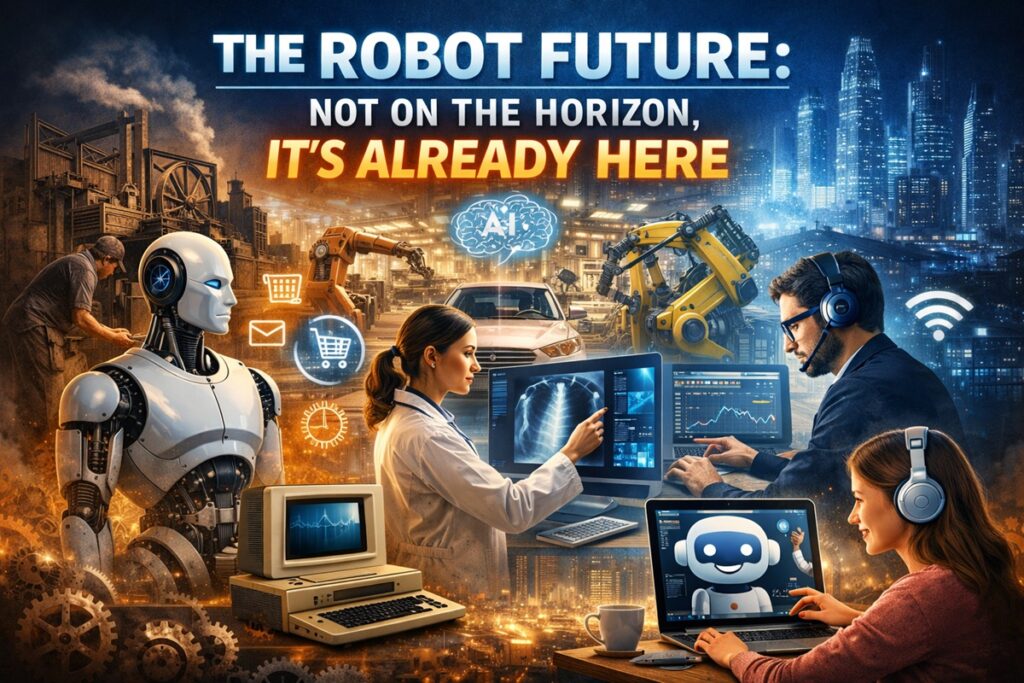
“The long-predicted robot future isn’t on the horizon. It’s already here, and it’s already clocked in.”
Look around! You’ve likely already interacted with your new digital colleagues. They are chatbots answering your midnight shopping questions, the algorithms recommending your next binge-watch, and the automated arms on factory floors assembling everything from cars to smartphones.
Artificial Intelligence (AI) is no longer a fragment of science fiction; it is the fundamental new reality reconfiguring the very bedrock of how we work, live, and conduct business. This has sparked widespread anxiety about AI job replacement and what it means for the average worker.
This current technological jolt feels unprecedented in its speed and scale, but history offers us a reassuring pattern. Remember the societal upheaval caused by the steam engine? The profound shift brought by widespread electricity? The world-shrinking introduction of the personal computer? Each of these industrial revolutions sparked the same fundamental human fear: “Will these new machines make us obsolete?”
A Brief History of Industrial Revolutions
To understand where we are going, we must look at where we have been:
- The 1st Industrial Revolution (c. 1760-1840): Powered by steam, mechanization, and textile innovation. This era shifted primary power from human and animal muscle to mighty machines.
- The 2nd Industrial Revolution (c. 1870-1914): Driven by electricity, mass production, and the revolutionary assembly line. Everything got faster, bigger, and more interconnected.
- The 3rd Industrial Revolution (Late 20th Century): The Digital Revolution, born from the silicon chip. Computers and the internet shrank the globe and gave us the power of information at our fingertips.
- The 4th Industrial Revolution (Now!): This is our chapter. It’s defined by the fusion of AI, Robotics, the Internet of Things (IoT), and biotechnology. Unlike its predecessors, this revolution is blurring the lines between the physical, digital, and biological spheres, and it’s unfolding at an exponential pace.
From the sophisticated, coordinated dance of robots in Amazon’s fulfillment centers to AI diagnostic tools that can spot a subtle tumor in a medical scan long before the human eye might see it, the future is not a distant concept: it is being built today.
But this rapid integration forces us to ask a critical question: Is this path leading us toward a utopia of efficiency, or are we unknowingly writing a cautionary tale about human redundancy?
The Great AI Dependency Debate: Smart Tool or Crutch?
Let’s cut to the chase: Yes, modern businesses are becoming increasingly—and in some cases, profoundly—dependent on AI. And from a pure business perspective, it’s easy to see why. The immediate benefits are like a potent, productivity-boosting super-shot.
But like any powerful tool, from fire to the internal combustion engine, over-reliance without proper safeguards can be catastrophic. Are we building a ladder to the stars, or a beautifully complex but fragile house of cards?
The Sunny Side: The Irresistible Allure of AI
1. Efficiency on Steroids
AI excels at automating the tedious, repetitive tasks that consume valuable human hours. Think data entry, invoice processing, and initial-tier customer service queries. These systems operate at lightning speed, 24/7, with a significantly lower risk of human error. This automation frees up the workforce to focus on tasks that require a uniquely human touch.
2. The Data-Driven Crystal Ball
In the age of Big Data, humans are often overwhelmed by the sheer volume of information. AI algorithms, however, thrive in this environment. Companies now leverage AI to sift through petabytes of data to spot emerging market trends, forecast consumer demand, and guide high-level business strategy.
3. The Bottom-Line Benefits
Let’s be frank: AI doesn’t require a competitive salary, health benefits, or a two-week vacation. This makes it an incredibly cost-effective force for tasks it’s programmed to handle. The initial investment is often quickly offset by long-term savings in labor and increased output.
The Shadow Side: The Inherent Risks of AI
| Risk Factor | Description |
|---|---|
| Single Point of Failure | If a central AI system glitches, gets hacked, or goes offline, the entire operation can grind to a halt. |
| The “Use-It-Or-Lose-It” Brain | Outsourcing critical thinking to AI risks the “de-skilling” of the workforce, where human intuition rusts from disuse. |
| Garbage In, Gospel Out | AI models learn from data. If that data contains biases, the AI will amplify those biases at an industrial scale. |
| The Privacy Predicament | AI systems require vast amounts of data. Over-dependence increases the risk of misuse, surveillance, and privacy breaches. |
| Public Distrust | A Pew Research study found that a majority of Americans are uncomfortable with AI making hiring and firing decisions, citing concerns about fairness and oversight. |
The Million-Dollar Questions, Explored
Can AI Truly Replace Human Decision-Making?
The nuanced answer is: It can replace the computational part, but not the judgment. AI is a brilliant calculator, but it remains a terrible judge.
It can analyze a universe of data in seconds, identifying patterns invisible to the human eye. But it possesses zero innate capacity for empathy, ethics, or creativity. It cannot “feel the room” in a tense negotiation or understand the nuance of a cultural context. The final, most complex, and morally significant decisions will, for the foreseeable future, require a human heart and mind.
Is AI a Job Destroyer? The Truth About AI Job Replacement
The verdict is now clear: It is unequivocally both. The narrative of a simple “humans vs. machines” showdown is outdated. What we are witnessing is not a wholesale replacement, but a “great global reshuffling” of work.
AI is poised to automate many routine tasks. The fear of AI job replacement is not entirely unfounded. Routine tasks are increasingly automated. However, history suggests that technology creates as many roles as it eliminates. But in doing so, it will free human workers to “level up” into more creative, strategic, and supervisory roles. The job market of the future will emphasize skills that are uniquely human.
A Detailed Tour of the AI-Human Hybrid Workplace
- Manufacturing: Robots handle welding and assembly with precision, while AI predicts machine failures. The human role evolves to overseeing these systems, managing logistics, and innovating new products.
- Healthcare: AI outperforms humans in analyzing radiology scans. However, the human professional remains irreplaceable in providing a compassionate bedside manner and making fraught ethical decisions.
- Finance: AI executes high-frequency trades and detects fraud. Human advisors focus on building trust with clients and navigating complex, “gray-area” judgment calls.
- Education: Adaptive learning platforms tailor lessons to individual students. This liberates the human teacher to act as a mentor, inspiring critical thinking and providing social-emotional support.
- Marketing: AI crunches consumer data to optimize ad spend. The human marketer then shifts to the art of the craft: creating emotional, compelling brand stories.
Statistic to Consider: Institutions like McKinsey research suggests that AI could disrupt up to 50% of current work activities. However, it is also projected to create millions of new job roles that we can barely conceive of today—think “AI Ethicist,” or “Virtual Reality Experience Designer.”
The Future is Hybrid, Augmented, and Human-Centric
The post-pandemic world forcibly introduced us to the hybrid workplace. AI is now poised to be the engine that supercharges this model, creating what we might call the “Augmented Workplace.”
Imagine a near-future where:
- Your AI virtual assistant proactively prepares your meeting briefs and summarizes your emails.
- AI-driven project management tools predict potential bottlenecks before a project derails.
- “Smart” offices use IoT sensors to adjust lighting and temperature to optimize for employee well-being.
Conclusion: Revolution or Destruction?
The evidence points overwhelmingly toward a collaborative revolution. The most successful future of business is not a story of humans or robots. It is the story of humans and robots, working in a synergistic partnership.
The true “robot takeover” was never about enslavement. It’s about augmentation and partnership. Ultimately, the narrative of AI job replacement is too simplistic. The real story is one of transformation and adaptation. It’s about building a world where technology handles the tedious, so humanity can reach for the sublime. And if we navigate this transition with wisdom and a commitment to our uniquely human qualities, that future doesn’t just look interesting—it looks truly exciting.